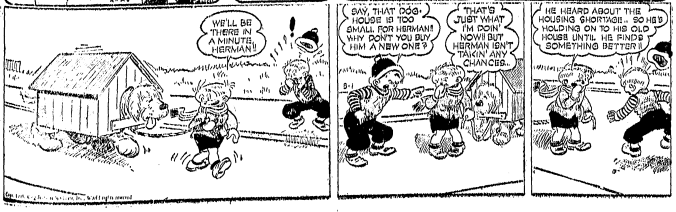
Lexington Leader (1945)
In 1945, after returning home following the end of World War II, Flight Officer Robert R. Pierson discovered his hometown was experiencing an acute housing shortage. While this syndicated comic strip offers a humorous spin on the crisis, it is also indicative of how the housing shortage dominated local and national news at the time.
From at least the late nineteenth century, when the county first began maintaining plat books, Lexington has been extending its boundaries outward by developing suburbs. In fact, a 1940 housing survey reported residential construction in the county had exceeded that in the city every year since 1925.
But until the 1950s, the expansion was slow, and the number of lots platted in each new subdivision was typically small. That would change following World War II. Not only did the number of suburbs expand rapidly, but they were also much larger than those that had preceded them. The critical shortage of housing, long-term mortgages, especially available to veterans, increased automobile ownership; advances in building technology; and the Baby Boom, resulted in the most dramatic stage of urbanization Lexington had ever experienced.
During the war years–1941 through 1945–only 113 homes were constructed in Lexington and Fayette County. As soldiers returned, hoping to start families, they were faced with an acute housing shortage. In 1946, around 300 new homes were constructed, more than doubling the four-year total completed during the war. But, continued material shortage, demands for construction labor, cost of construction, and government regulations slowed progress. Analysts believed the shortage could be eliminated with the construction of another 700 homes. A goal some optimistically believed could be quickly met.
Yet, two years later, in 1948, analysts estimated it would take an additional 10,000 units to end the housing shortage. One Lexington relator estimated the housing supply and demand would not attain a balance before 1951 or 52. At the time, it was estimated that slightly more than 98 percent of the residential property within the Lexington corporate limits was already “built up.” While a few old houses were being razed and replaced, the figure was negligible. The bulk of new housing would take place in the suburbs.
A 1950 headline in the Lexington Herald Leader pronounced–
“Lexington Subdivision Development Booming.”
Within five years following the war, approximately 3,500 residential building lots had been made available through the development of new subdivisions and expansions of old ones, primarily east and south of town, the article reported.
“The community of Lexington is spilling over farther and farther into the county. The city is surrounded by new subdivisions and more are being planned” (Herald Leader 03/19/1950).
When Robert R. Pierson returned from military service in 1945, he moved back to the family farm, 291 Rosemont Garden, south of town. His father, Andrew Clinton “A.C.” Pierson, died two years before Robert’s return, but before his death, he had begun subdividing the land surrounding the family farm. The first section of Rosehill subdivision was approved in 1939. It included portions of Rosemont Garden, Clays Mill, and Mitchell Ave. After his military service, Robert Pierson took up where his father left off, quickly becoming one of Lexington’s most successful subdivision developers.
In 1950, the Lexington Herald Leader listed the Lexington subdivisions that had opened since the end of the war; two were developed by the 28-year-old Robert R. Pierson:
CHATHAM VILLAGE. Approved July 29, 1947. 83 lots. McCubbing, Springhill and Lafayette drives and Clays Mill. Chatham Village began as early as 1939. Over time, there were numerous additions to the subdivision, including Robert Pierson’s 1947 development.
PROSPECT HILL. Approved on November 17, 1949. 38 lots. Lynn Road and Harrodsburg Pike.
On April 23, 1953, the city approved Pierson’s largest development to date, Skycrest. The first unit of the subdivision consisted of 149 lots located on Cheryl Lane, Lynn Road, and Faircrest Drive.
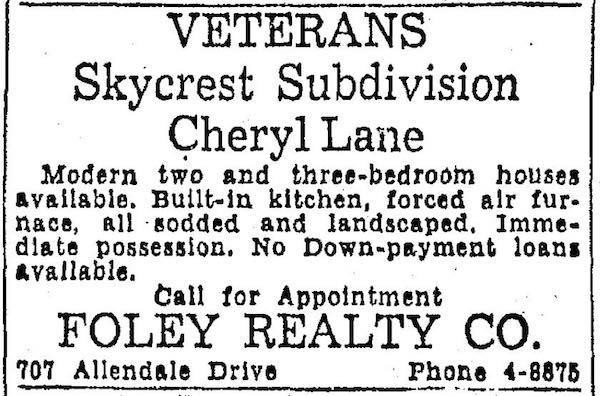
Lexington Herald (May 7, 1954)
Pierson joined with a group of other developers, including Ted Osborn, and soon got approval for two additions to Skycrest, including another 150-plus lots on Della, Furlong, and Windsor Court, making Skycrest one of Lexington’s largest subdivision developments to date.

Lexington Herald (March 22, 1954)
In January 1954, the Lexington Herald Leader reported:
“Subdivisions continued to ‘blossom,’ and perhaps the speediest single development noted during 1953 was that of Skycrest off the Harrodsburg Pike, where approximately 160 homes were built.”
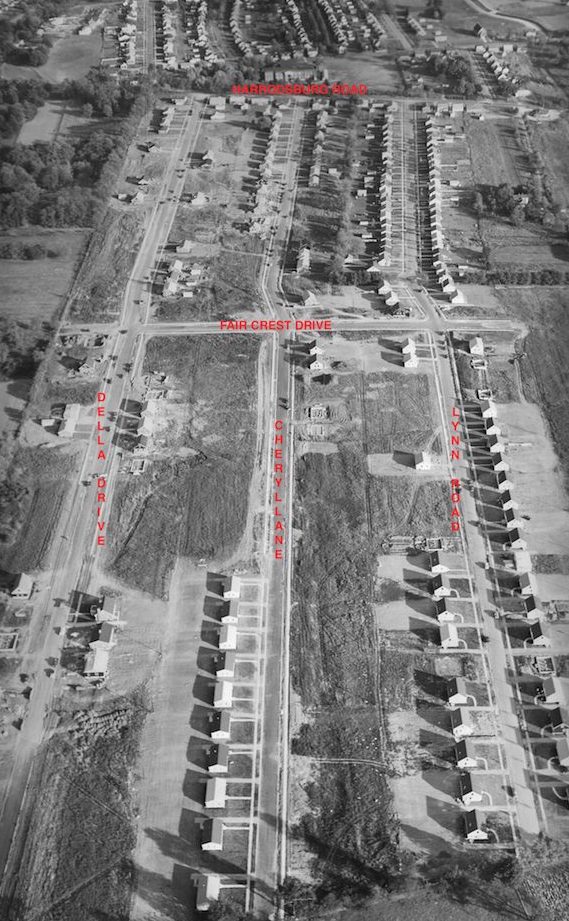
Prospect Hill and Skycrest Subdivisions, c. 1954 (Trapp Communications, LLC. archive). Annotations by author.
In 1954, Robert Pierson, his wife Margery, mother Lucy, and father and mother-in-law, O.G. and Kathryn Schwant of Logan, WV, filed articles of incorporation for the Gardenside Development Co., Inc. The recorded purpose of the corporation was “to develop real estate and engage in similar activities.”
Robert Pierson was preparing for his biggest development yet–GARDENSIDE.
 Growing Gardenside