Lexington’s Post World War II Subdivision Boom

Lexington_Herald_1945-03-01_15

Lexington Leader (1945)

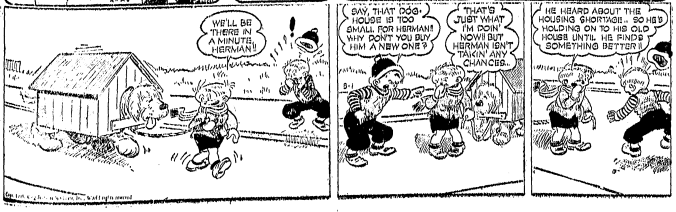
In 1945, after returning home following the end of World War II, Flight Officer Robert R. Pierson discovered his hometown was experiencing an acute housing shortage. While this syndicated comic strip offers a humorous spin on the crisis, it is also indicative of how the housing shortage dominated local and national news at the time.

From at least the late nineteenth century, when the county first began maintaining plat books, Lexington has been extending its boundaries outward by developing suburbs. In fact, a 1940 housing survey reported residential construction in the county had exceeded that in the city every year since 1925.
Continue reading

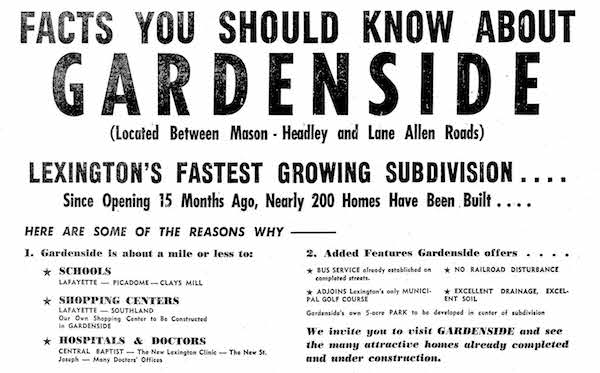
Lexington’s Fastest Growing Subdivision

Lexington_Herald_1955-09-11_46

Lexington Herald (September 11, 1955)

Robert Pierson wasn’t a house builder, he was a real estate entrepreneur.  After acquiring and surveying land, developing a plan, laying out building lots and roads, and improving the overall site, he sold lots to builders who would often acquire several parcels at a time to construct homes for resale.

After developing the Prospect Hill and Skycrest subdivisions, both of which fronted on Harrodsburg Road, Pierson and his business partners set their sites on a large section of adjoining land bound by Harrodsburg Road, Mason Headley, Lane Allen, Parkers Mill, and Versailles Road. The community they planned, Gardenside, would ultimately be one of Lexington’s largest subdivisions; including over 2,000 homes.

Continue reading