
Examples of extant Gardenside awnings (all color photos by author).
Once a Gardenside staple, awnings are rapidly dwindling from the neighborhood’s landscape. Why were they so popular a generation ago? Why did they lose favor? Do surviving awnings have lessons to offer today?
Summer officially arrived last week. Soon the temperatures will rise, we will crank up the AC, and our utility bills will inevitably follow suit. Today, nearly all Gardenside homes have central air. That was not always the case. In fact, few Gardenside homes were built with air conditioning units. In nearly all cases, they were later additions. How did Gardenside’s original families weather Kentucky’s hot and humid summers?
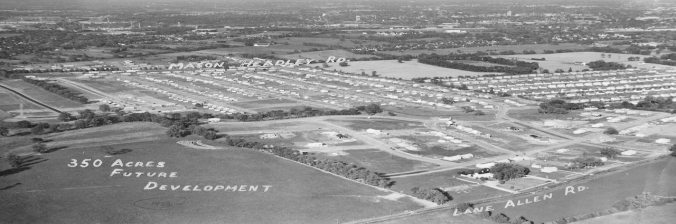
c. 1960 aerial of Gardenside.
Today, mature shade trees are one of Gardenside’s biggest assets. But that wasn’t the case when the neighborhood was first developed. Gardenside was built on former pasture land. Few original residents enjoyed the shade we relish today.
The two dissecting tree lines in the forefront of the c. 1960 photo above outline Wolfrun Creek and a farm road that would eventually be incorporated into Alexandria Drive. The circular formation of trees in the right background near Mason Headley Road enclosed a horse track that would eventually be incorporated into the Headley Green neighborhood.
Because Gardenside was built on former pasture land, few homes had mature trees. One exception is a cluster of large trees surrounding a house located adjacent to Lane Allen Road. That is the location of one of the original farmhouses, known in the 19th century as Cove Spring. The home, a portion of which reportedly dates to 1806, is still extant (937 Lane Allen). In a future post, I will focus on this large agricultural estate and discuss its transformation into a mid-century modern subdivision.
Back to the subject of today’s post–how did Gardenside’s original residents survive in Kentucky’s hot and humid summers without air conditioning or shade?
While air conditioning was widely available, during Gardenside’s development it remained a luxury. According to an article that ran in the Lexington Herald on September 23, 1956, a central air-conditioning system for the averaged sized five or six-room house cost about $1,000–half of what it cost just 15 years earlier. The biggest savings came from declining installation charges due primarily from new compact designs which eliminated the complicated installation formerly required.
Despite the rapidly falling prices, few Gardenside homes were built with air-conditioners. But Gardenside was not alone. In 1967 only 29 percent of new homes in the United States had central air (James A. Jacobs, Detached America: Building Houses in Postwar Suburbs, p. 206).
At the time, builders laid the blame for the slow adoption of air-conditioning squarely on the shoulders of the Federal Housing Administration (FHA) and the Veterans Administration (VA). Due to geographic variance in market preferences, neither agency had a national policy on air-conditioning. When appraising a home for a government-backed mortgage, it was left to the local field office to decide how much weight was to be given to an air conditioning unit. Both agencies also figured the cost of operating the unit when deciding wether to approve a loan. In 1956 they cost about $100 a year to operate–next to the furnace the most expensive appliance in a house. If the appraiser considered it to be more than the prospective buyer could afford, neither agency was willing to make the loan (Lexington Herald, September 23, 1956).

Headline from Lexington Leader, November 14, 1963.
Most of Gardenside’s original homeowners couldn’t purchase a home without an FHA or VA approved mortgage (a future post will focus on the significant role the FHA and VA played in Gardenside’s development). It’s probably fair to assume most families would have loved to have had a unit in their new home, particularly since they were sitting in the middle of a sunny pasture. Most, however, were simply not willing to take the chance of having their mortgage declined. So while nearly all of us have central air today, in most cases, they are later additions. 
Lexington Herald, May 28, 1947.
Instead of air-conditioning, many Gardenside homeowners turned to an inexpensive and practical solution to cool their new home–awnings. At mid-century, Lexington newspapers were filled with awning advertisements like the one above. Lexington Tent & Awning’s 1958 advertisement for Durawear brand awnings (below) indicates another reason for their popularity. While at the time, a family couldn’t be sure if the FHA and VA would approve a loan for a home with central air, the Durawear advertisement indicates they could qualify for an FHA 36 month no down payment loan to purchase the next best thing–awnings.
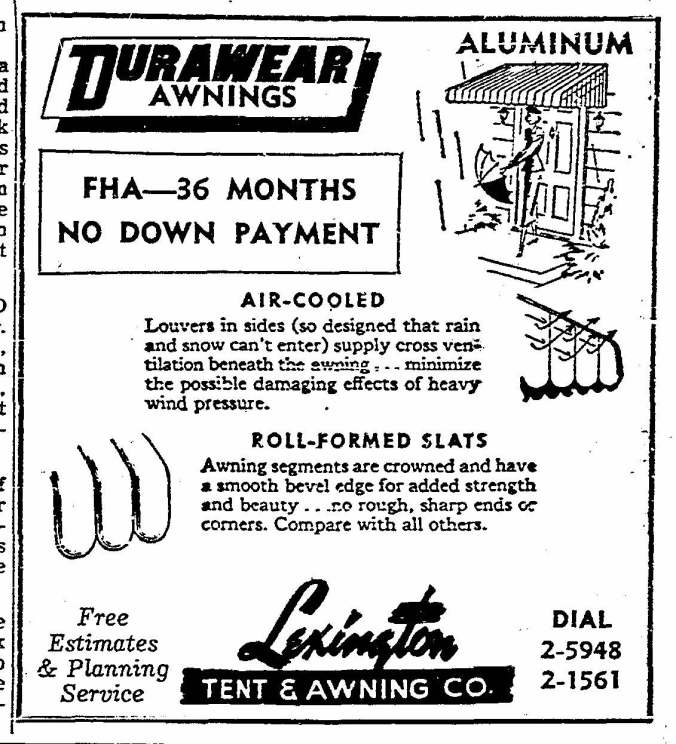
Sunday Herald-Leader, March 1958.
The advertisement below suggests, at mid-century, awnings were considered so valuable Gardenside builders and owners included them along with the amenities they thought would best help sell their house (location, material, size, garage).
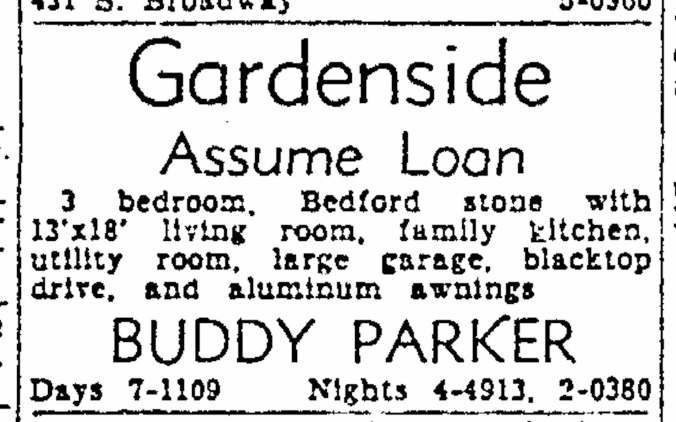
Lexington Herald, April 1960.
Why were awnings considered such a valuable mid-century home feature? Did they substantially cool homes? Once a family purchased a central air unit, were awnings absolute? Were there other reasons for their popularity? A review of local newspapers offers some clues.
Since awning production has traditionally been a shady business, let’s consider that aspect first.
began an article that appeared in the Lexington Herald in April 1963. The author suggested:
Whether you now use air-conditioning, are wondering whether to install it, or determined to survive without it, awnings can help you save money.
By keeping windows from heating up, the author claimed awnings may increase the efficiency of air-conditioners by as much as 28 percent. If homeowners are in the market for a unit, the author suggested, they should also consider awnings since they may be able to save money by purchasing a slightly less-powerful cooling unit than otherwise.
These are big claims. But this author wasn’t alone. Many articles and advertisements in mid-century Lexington papers made similar assertions about the cooling potential of awnings. Take, for example, the 1947 Koolvent advertisement displayed earlier in this post and the Aluma Kraft advertisement below. Both suggest awnings can make a home 10-20 percent cooler. I can imagine that would be an attractive claim if your new home was located in the middle of a pasture.

Lexington Herald, April 12, 1954.
I know what you are probably thinking, “these fifty plus-year-old claims can’t possibly be true! They were written by charlatans trying to sale nieve homeowners a bunch of useless aluminum awnings.” Until undertaking this research, I was with you. Turns out, more recent research indicates, in some cases, they may actually have been underestimating the cooling potential of awnings.
A 1994 U.S. Department of Energy study, for example, concluded:
Although their effectiveness can be affected by many factors including location, climate, window size, and glass type, the energy efficiency advantages of awnings are clear… awnings can reduce heat gain up to 65% in south facing windows and up to 77% on windows facing east. Awnings reduce stress on existing air conditioning systems and make it possible to install new HVAC systems with smalleer capacity, thus saving purchasing and operating costs… When used with air conditioners, awnings can lower the cost of cooling a building by up to 25% (Cooling Your Home Naturally, Office of Energy Efficiency and Renewable Energy Factsheet).
At a period when most houses didn’t have central air, the cooling potential was clearly the primary benefit of window awnings, there were other selling points, however. Proponents frequently suggested window awnings could help keep windows cleaner, allow them to remain open when it was raining, protect surrounding paint surfaces and trim, reduce window ice formation, and help protect furniture, woodwork, rugs, drapes, and other interior furnishings that can be damaged by sun rays.
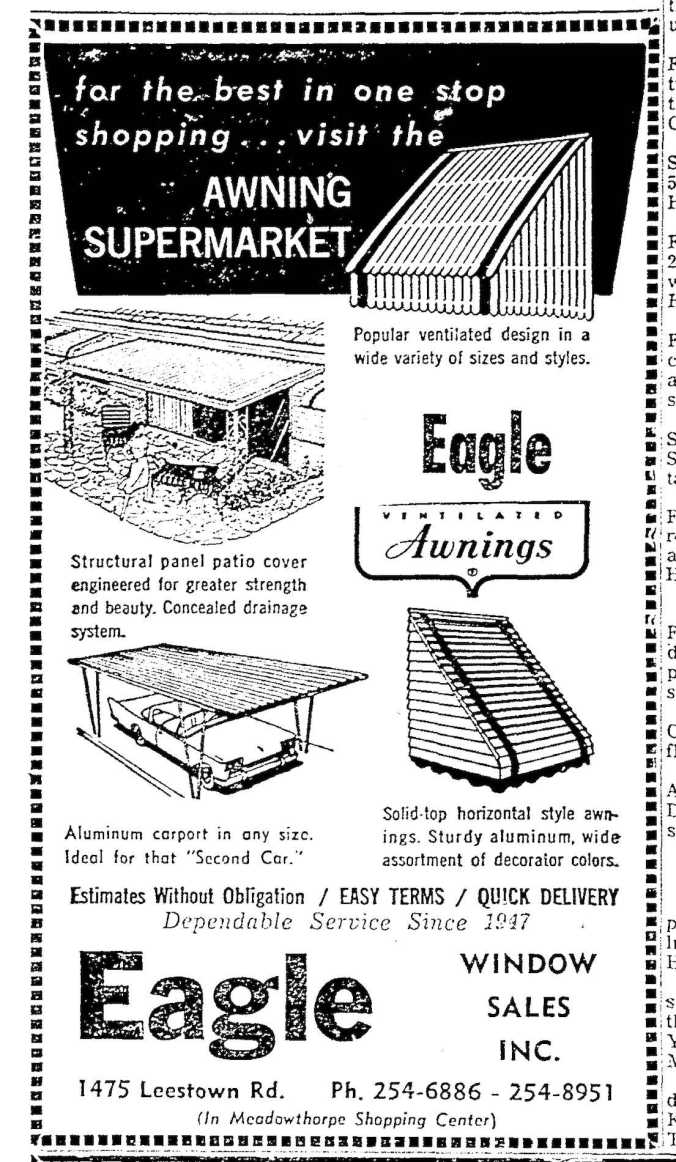
Lexington Herald, April 5, 1963.
Considering their usefulness and cost-effectiveness, it’s not surprising that awnings were never limited to Gardenside windows. They were commonly used by neighborhood homeowners as door hoods, porch and patio canopies, and even carports; allowing families to experience the outdoors at any time, even during bad weather (see image above). As the image below indicates, and we will see in a future post dedicated to the topic, capturing outside space, bridging the inside and outside, and casual living were the reason many midcentury families moved to suburbs like Gardenside.
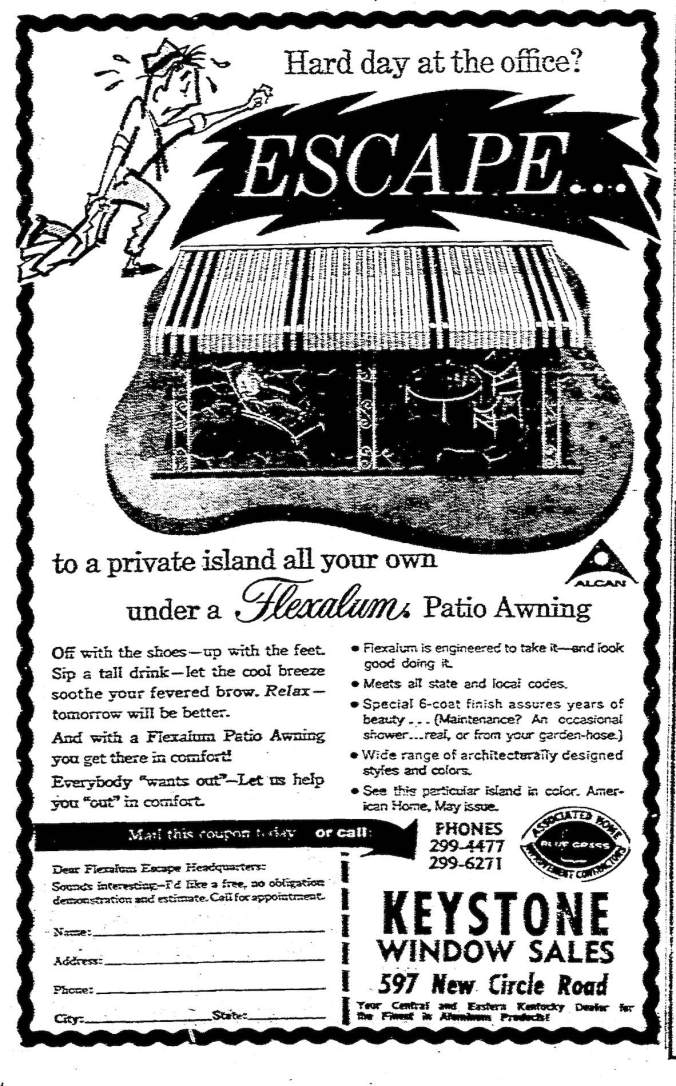
Lexington Herald, May 10, 1965.
So what types of awnings typically graced Gardenside homes at mid-century? A survey of extant homes and mid-century newspapers reveals a wide variety of popular awning types, materials, and styles.

Extant fiberglass and steel awnings in Gardenside.
While canvas had previously dominated the market, in the 1950s aluminum became the most popular awning type because it was considered to be longer-lasting and lower-maintenance. Fiberglass and steel awnings were also available at mid-century. While aluminum clearly dominated the market, the images above suggest Gadenside homeowners were also willing to experiment with fiberglass and steel. The last example above appears to be identical to the steel awning pictured in the 1956 Lexington Tent & Awning advertisement below.

Lexington Leader, April 22, 1956.
Aluminum awnings are made with slats called “pans” arranged horizontally or vertically, both types of which are still extant in Gardenside. While manufactures offered a wide variety of solid colors, slats could be arranged to create strips, as depicted in the Sears full-page advertisement below and the Gardenside awnings that follow; offering homeowners a great variety.

Gardenside awnings with horizontally and vertically arranged slates.
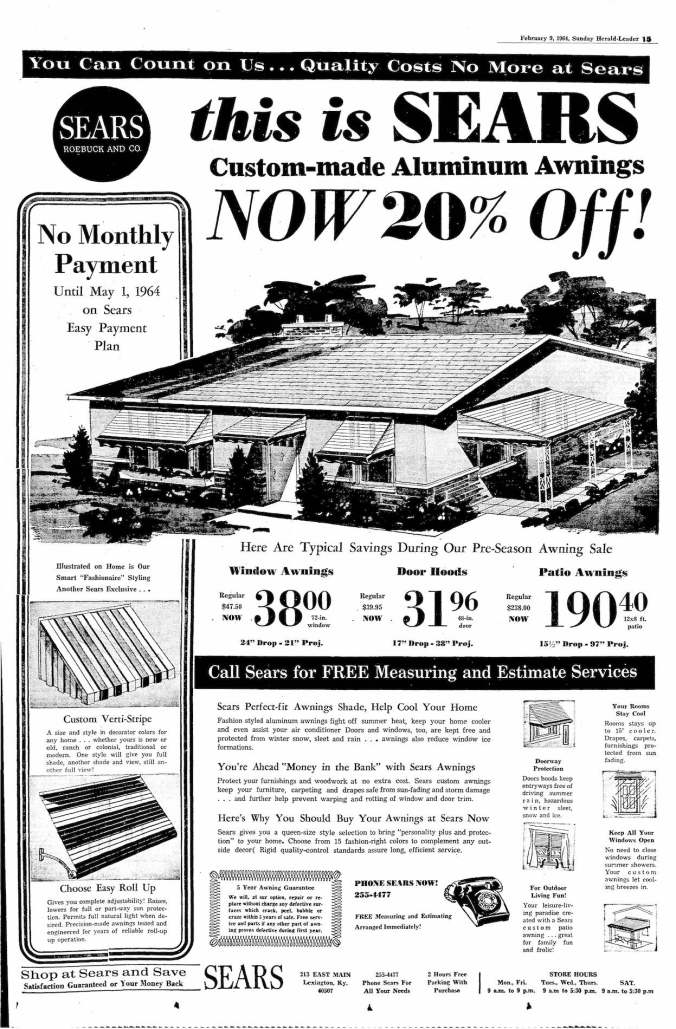
Lexington Leader, February 9, 1964.
As the Zephyr advertisement below suggests, advancements in aluminum manufacturing meant awnings could vary in shape as well. Straight, convex and concave models can still be found throughout Gardenside. Homeowners could also choose between awnings with sides or sideless models.

Lexington Herald, March 14, 1954.
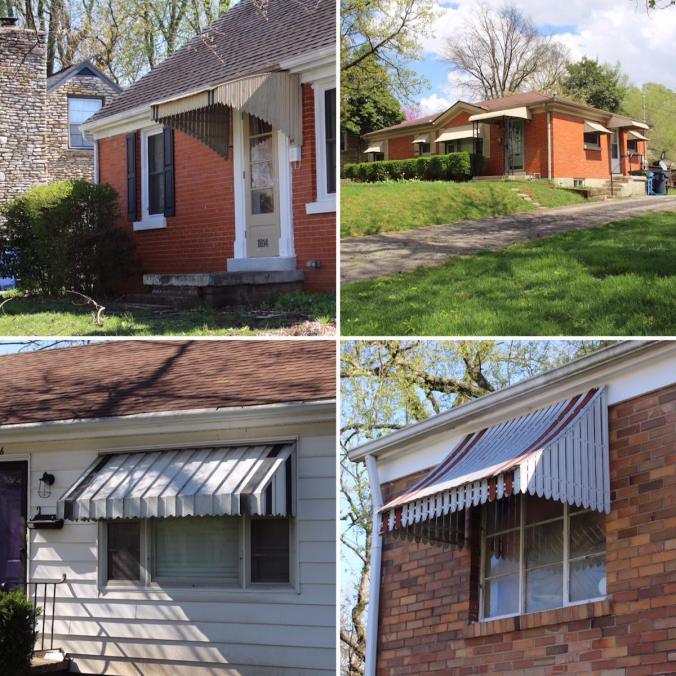
Examples of straight, convex and concave model awnings in Gardenside.

Lexington Leader, March 14, 1954.
Advancements in aluminum also allowed for the development of new ventilated awnings. As suggested by the very name of the model advertised above, “Ray-O-Lite”, one of the major criticisms of awnings was, while they block the unwanted heat of the sun, they can also darken the interior of a home. The ventilated awning allowed some diffused sun to still enter the home.
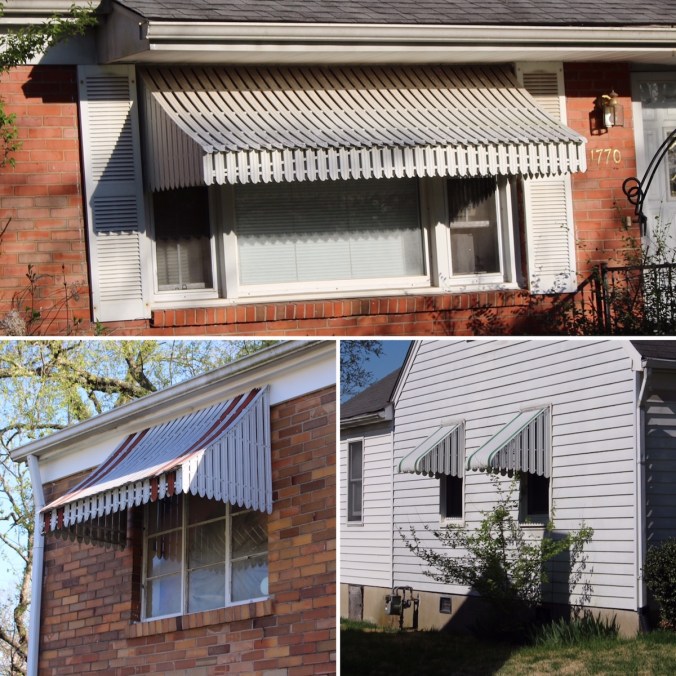
Ventilated awnings in Gardenside.
While many awnings were fixed, bolted and locked to a frame, by mid-century manufacturers were offering operable roller models which could be adjusted to allow more sun into the home.
The wide variety of window types (the subject of a future post) is one important characteristic of Gardenside and other mid-century suburban homes. To respond to the variety, manufacturers customized their awnings, making it possible to purchase models for any type of window, from casement to picture windows. Casement window awnings, for example, were box-like in shape to accommodate the outward swing of the vertical sash.
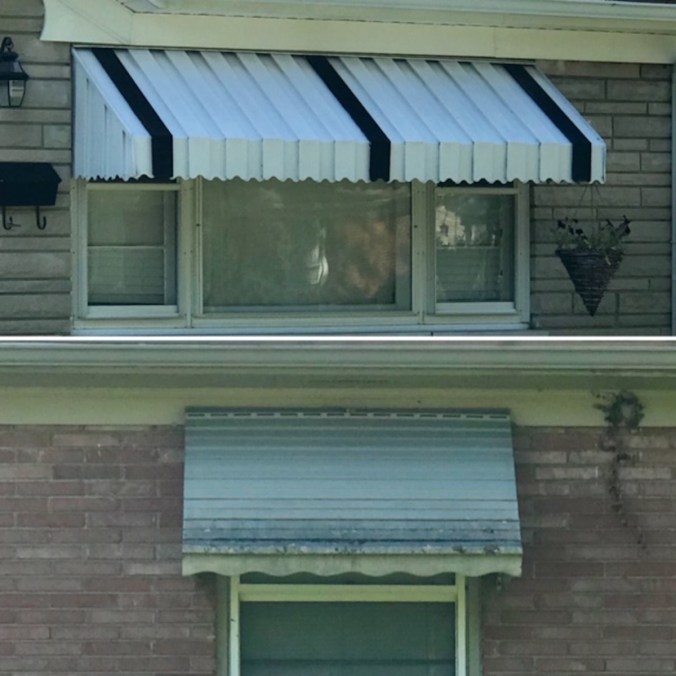
Aluminum awnings mimicking the valance of cloth awnings.
While aluminum awnings were popular because of their modern material, some manufacturers designed models that mimicked the free-hanging valances, the flapping bottom pieces characteristic of the canvas awnings that were ubiquitous in nineteenth and early-twentieth-century Lexington.
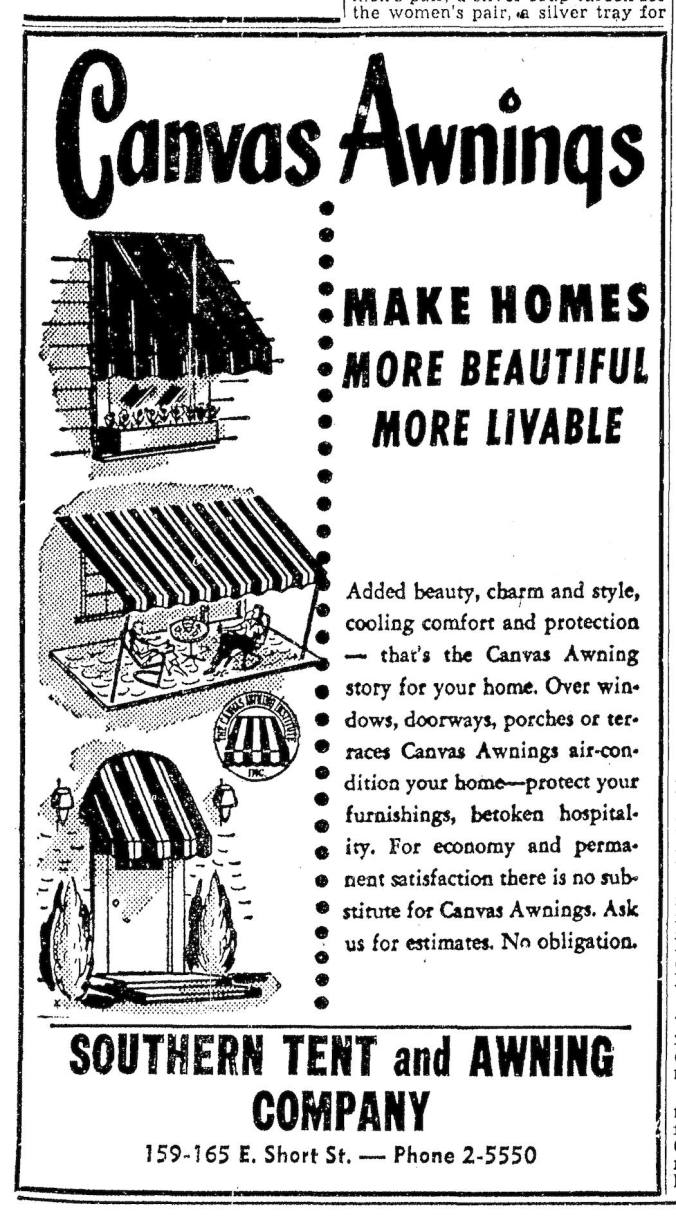
Lexington Leader, May 16, 1954.
While the 1950s and 1960s saw the rise of the aluminum awning market, fabric manufacturers responded by developing more durable, slow-fading, mildew resistant materials. As a result, while aluminum models dominated Gardenside’s landscape, they never completely replaced fabric awnings. In addition to new fabrics, there were also advancements in hardware, which allowed cloth awnings to be easily raised and lowered, keeping them relevant to the postwar ranch house. Many cloth awnings can still be found throughout the neighborhood.
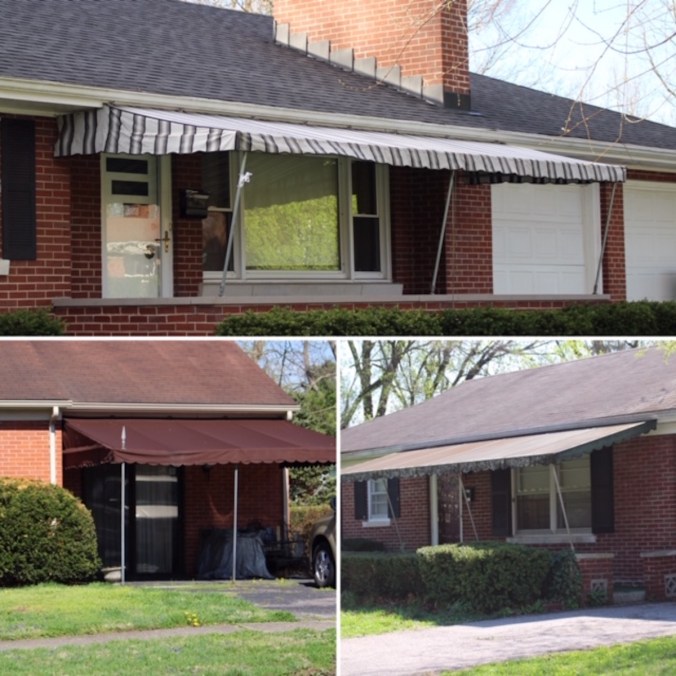
Examples of extant canvas awnings.
Despite their effectiveness, once Gardenside homeowners obtained central air, many removed their awnings or at least stopped maintaining them. Often new owners of homes that haven’t been maintained well for decades can’t wait to get a chance to rip off the old, rusty, and faded awnings. While there are still a number of homes with awnings in the neighborhood, their numbers are rapidly dwindling.
Again, Gardenside is not alone. In 2012, Retro Renovation reported awnings were one of the ten most endangered features of midcentury homes. Environmental concerns have ushered in a renewed interest in awnings, however. With a resurgent interest in sustainable design, people are starting to reconsider awnings–an old-time low tech common sense solution to cooling the home.
Depending on how much your home is shaded by trees, awnings could make a significant difference in your summer energy bills, and by making them more efficient they might just help an aging HVAC system limp along for a few more years. At the same time, they add some retro curb appeal to your home.
For those who live in homes already fitted with awnings, think twice before deciding to remove them. The National Park Service has a detailed Preservation Brief all about window awnings, including how to care for vintage ones still on your home. Its focus is principally on historic commercial structures, but I think you will still find it useful.
So your Gardenside home has lost its awnings or may have never had them, but you are environmentally conscious and curious about where you might be able to find some retro awnings appropriate for the type of homes built in Gardenside in the 1950s and 60s. Check out this article in Retro Renovation. The author offers information about nine places where you can buy “retro style” aluminum awnings including companies in business since the 1940s. Better yet, use the advertisements included in this post as a starting point to begin a research project to determine if any of the Lexington companies are still manufacturing 1950s-1960s style aluminum awnings. And please let us know what you discover. Finally, if you have awnings, please tell us about them. Add photos if possible.


 Growing Gardenside